
By Cory Viveiros, MS, ATC, LAT, CES
Injury Prevention Specialist, Fit For Work
Key Insights
- Injury prevention is a team effort and requires collaboration from all departments.
- Poor communication restricts the flow of safety information and often results in higher rates of injury.
- Developing a strong culture of communication requires a focus on building relationships.
Injury prevention work often focuses on the physical cause of injuries, such as lifting mechanics, repetitive movements, and environmental hazards. Those factors are an integral part of the solution, but a culture of communication maximizes effectiveness by improving the flow of information. Information then becomes action, leading to earlier intervention for musculoskeletal injuries and discomfort, improved employee engagement, and greater trust between employees and leadership.
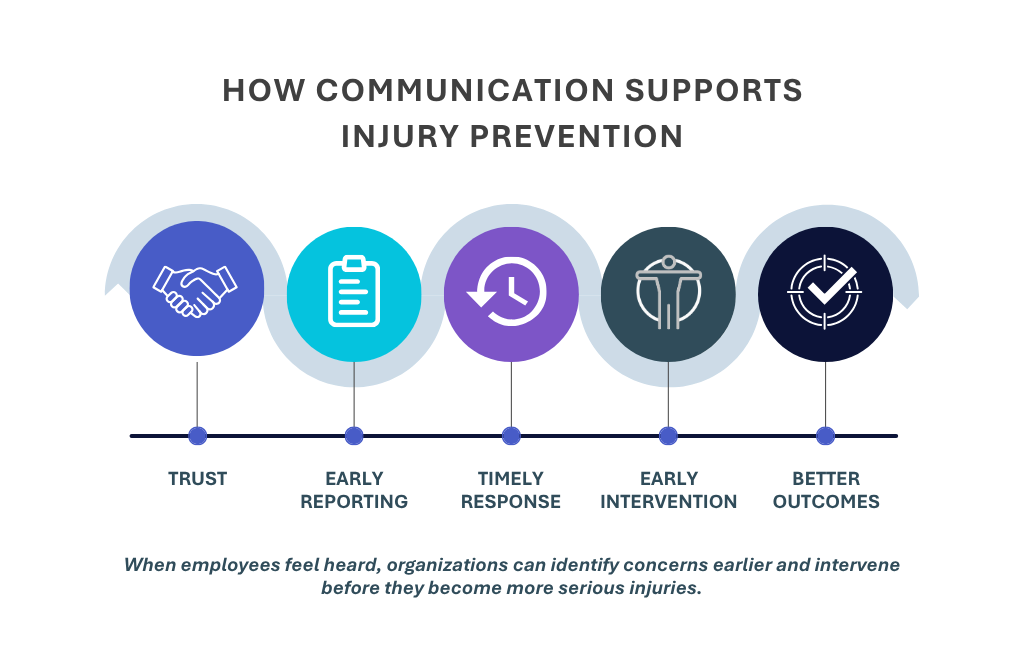
A strong culture of communication creates champions when employees see that their voices are heard.
Injury Prevention Begins with Information
The goal of injury prevention is straightforward: identify risks before they become injuries. Achieving that goal depends on timely communication from day one. New hire presentations and training on safe lifting begin developing rapport with employees. They should be aware that injury prevention specialists are there to support employee well-being instead of simply reporting infractions. As those relationships strengthen, employees get comfortable seeking the provider out for assistance with onsite issues or soreness that develops at home.
Injury prevention specialists also form an important bridge between what is happening onsite and leadership. Open lines of communication between providers, employees, supervisors, safety, and other leadership create opportunities to:
- Recognize injury trends before they become widespread.
- Identify employees who are beginning to experience discomfort.
- Adjust work practices before symptoms progress into recordable injuries.
- Reinforce safe movement strategies during the workday.
- Collaborate with supervisors to modify tasks that present unnecessary risk.
OSHA identifies worker participation and communication as key elements of effective safety and health programs, reinforcing the importance of creating clear channels for employees and leaders to share information.
The Business Impact of Poor Communication
When critical information does not reach the right people, chances of workplace injury increase. The communication breakdowns with the biggest impact often seem deceptively minor:
- An employee experiences shoulder discomfort for two weeks without mentioning the issue because they are not sure who to tell.
- Safety and operations each recognize pieces of the same problem without ever sharing information.
- Injury prevention specialists are not informed about production changes that significantly increase physical demands.
- Delayed response to issues damages employee trust.
Without proper communication in place, easily addressed early warning signs are overlooked until injuries occur, requiring medical attention or time away from work. In one employee, a musculoskeletal injury incurs the cost of care and lost productivity. On a greater organizational scale, multiple employees experiencing injuries compound both the expense and impact on operations rapidly.
Have you checked the pulse in your organization lately? If recordables are trending higher and morale is slipping, poor communication is a likely culprit. Raise awareness of common disconnects and develop simple strategies to communicate more effectively.
Building Organizational Trust Through Communication
Building relationships is a key area of focus, particularly for injury prevention providers. From employees to leadership, company-wide buy-in creates a foundation of trust to support successful initiatives. It is important to remember that trust is created through consistent communication and everyday interactions such as walking the floor, good listening practices, and following up on previous conversations.
For practical strategies that strengthen trust, listening, and employee engagement during workplace conversations, read our related article, Quality Interactions: Achieving Behavioral Change Through Human Connection.
Safety is a Team Sport
No single department in an organization owns injury prevention. It requires collaboration between operations, supervisors, safety professionals, human resources, onsite injury prevention providers, and employees. Each unique perspective has significant value, clarifying the what and the why behind processes. Good communication between all groups improves visibility of concerning patterns and facilitates development of solutions. In an organization with a culture of excellent communication, practical application may follow these steps:
- Injury prevention providers note an increase in reported soreness from employees involved in a specific process.
- That trend is shared with relevant leadership and department heads—such as operations, supervisors, and safety—during regular meetings.
- Evaluation of the process determines whether it can be altered to eliminate the cause of employee soreness. If not, alternate mitigations are developed to reduce risk as much as possible.
- Solutions are communicated to employees and deployed promptly.
- Injury prevention providers and supervisors check in with employees regularly to monitor effectiveness of solutions and check for additional concerns.
Creating a Culture of Communication
Understanding an organization’s current culture is an important starting point when improving communication. Employees often fall into three categories:
- Concern sharers tend to voice concerns to other employees instead of supervisors, finding fault with the organization and not actually seeking improvement.
- Spectators often do not share their concerns, believing their voice and actions have little impact.
- Champions communicate their concerns constructively and actively participate in improvements.
A strong culture of communication should create an increasing number of champions as employees see evidence that their voices are heard, and leadership demonstrates genuine concern for their overall well-being. Those who feel disregarded and unheard are the most likely to become concern sharers, developing deep distrust and contributing to broken lines of communication. Opportunities to identify those individuals and re-engage them are plentiful if leadership and providers prioritize relationship-building.
Communication in Practice: A Real-World Example
One industrial site performs yearly safe lifting certifications. It is a rare opportunity to connect 1:1 with over 400 employees over the course of several months. While getting certified, injury prevention providers also ask what employees are seeing on the floor and if they have noticed issues. If so, the next question is whether the concern was brought to their supervisor. The answer is often no.
This pulse check not only uncovers potential safety problems, but it reveals breakdowns in communication. Providers can then share those observations with leadership to bridge gaps and facilitate improvement.
Conclusion
The strongest injury prevention programs are built not only on policies and practices, but also on communication. Communication connects people, processes, and prevention efforts, helping organizations identify risks earlier, respond more effectively, and create safer workplaces.
Learn how Fit For Work’s injury prevention specialists can help strengthen communication and prevention efforts across your organization by clicking here.

Cory Viveiros holds a Bachelor of Science in athletic training from Bridgewater State University and a master’s degree in exercise science and health promotion, with a focus on rehabilitation science, from Pennsylvania Western University. He is a board-certified athletic trainer through the BOC and licensed in both Rhode Island and Massachusetts.
Cory is also a certified Corrective Exercise Specialist (CES) through the National Academy of Sports Medicine. He spent 12 years in the Sports Medicine Department at Roger Williams University, including four as department head.
Since joining Fit For Work in April 2023, Cory has worked as an injury prevention specialist across various manufacturing and food distribution sites. He has led ergonomic initiatives for clients nationwide and serves as a mentor in the company’s new hire program.