
By Forrest Richardson, CSP, ARME
Director of Safety, Fit For Work
This article is Part 2 of our OSHA 2026 Preview series. In Part 1, we outlined key leadership changes and budget shifts shaping OSHA’s direction for the year. Here, we break down how OSHA calculates penalties and how employers can qualify for reductions.
Understanding OSHA Penalty Reductions (FY 2026)
Proactive safety and compliance can deliver substantial benefits. To illustrate this, we’ve broken down OSHA’s 2026 maximum penalties, and the standard reductions employers may qualify for.
OSHA adjusts civil penalties annually under the Federal Civil Penalties Inflation Adjustment Act; these updated maximums took effect January 15, 2025, and carry forward into FY 2026. The amounts set the ceiling for penalties before reductions for mitigating factors.
- Serious & Other-than-Serious Violations: up to $16,550 per violation
- Failure to Abate: up to $16,550 per day past the abatement date
- Willful or Repeat Violations: up to $165,514 per violation
These maximums form the starting point for all penalty calculations in FY 2026.
Standard OSHA Penalty Reductions
Employers can qualify for standard reductions based on history of compliance and prompt correction of hazards.
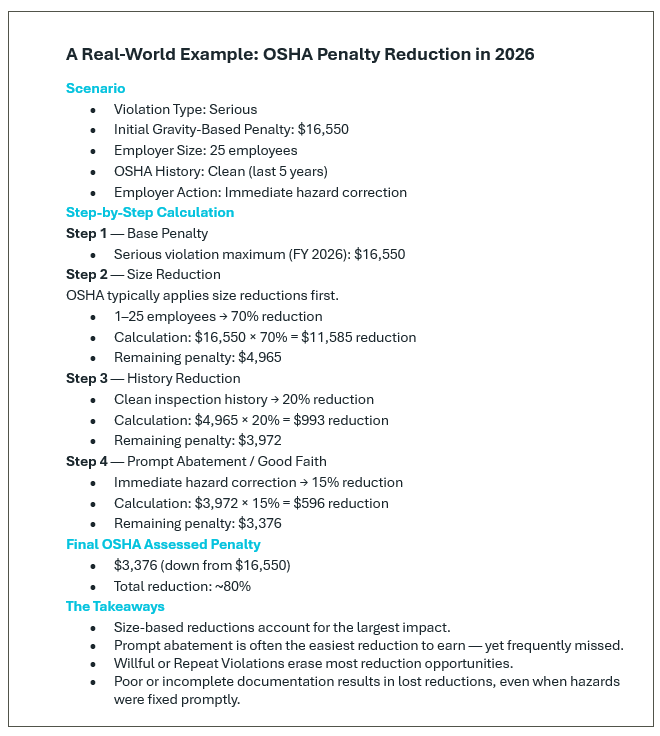
- History of Compliance (“No History” Reduction): Employers with a clean inspection record may receive a 20% reduction. This applies if the organization has either never been inspected by OSHA or an OSHA State Plan, or was inspected within the last five years with no serious, willful, repeat, or failure-to-abate violations.
- Good Faith / Prompt Correction Reduction: A 15% reduction may be granted to employers who take immediate steps to correct hazards once identified.
How Reductions Work Together:
OSHA typically applies reductions in a general sequence:
- Start with the base penalty.
- Adjust for factors including business size, history of compliance, good-faith efforts, and hazard severity.
- Apply eligible percentage reductions, such as 20% for history and 15% for prompt correction.
Reductions are discretionary, determined by OSHA on a case-by-case basis. Proactive documentation and transparency can make a meaningful difference.
How Employers Can Maximize Reductions
- Maintain a clean inspection history
- Respond to hazards immediately and transparently
- Document all corrective actions and abatement steps
- Demonstrate good‑faith cooperation during inspections
These practices support eligibility for both the 20% history reduction and the 15% prompt‑correction reduction where applicable.
Action Steps for Safety Leaders
To prepare for FY 2026, safety leaders should:
- Monitor Final Appropriations
Track updates in the Federal Register, follow OSHA and agency leaders on social media, and subscribe to OSHA Quicktakes Newsletter for weekly updates. - Strengthen Internal Safety Systems Now
Integrate occupational health and safety into daily operations. Review the OSHA Enforcement Page for national and local emphasis programs.
For additional training requirements and resources, see OSHA’s Training Requirements and Resources Library.
- Leverage Professional Networks for Best Practices
Engage with safety organizations. Many events do not require membership, and virtual learning options continue to expand. - Prepare for Collaborative, Data-Driven Enforcement
OSHA will continue releasing information about national and regional assistance programs. Even without new data‑collection requirements, ensure existing reporting is accurate and complete to support inspection readiness and demonstrate good faith.
Conclusion
OSHA’s direction for 2026 continues to emphasize practical compliance and worker‑centric safety, particularly in high-frequency, high‑hazard environments. Maintaining strong documentation, safe behaviors, and early awareness of OSHA updates will remain essential in reducing both employee injury and employer liability.
Fit For Work is committed to supporting organizations in achieving and maintaining compliance with OSHA standards. Contact us to learn more.

Forrest Richardson has served as the Safety Division Director for Fit For Work since 2004. He has over 30 years of experience in environmental health & safety (EHS) compliance management and leads national, regional, and local EHS Compliance services for Fit For Work. Forrest holds the Certified Safety Professional (CSP), Associate Risk Management Enterprise (ARME), and Certified Safety Manager (CSM) certifications. He also facilitates the Fit For Work Safety Specialist professional development track, supporting EHS podcasts, white papers, blogs, and safety newsletters.
Forrest proudly served in the United States Army 25th Infantry Division, Big Red One and 1st Calvary 227th Assault Helicopter Divisions. He is a professional member of the American Society of Safety Professionals, serving as chapter president, and supporting national professional development conferences. As a guest speaker he supports national, regional, and local professional development conferences across general, construction, and oil and gas industries.