By Jocelyn Thoresen, ATC, Guest Contributor
Generation Z workers, born between 1997 and 2012, are increasingly gravitating toward industrial jobs—a shift that’s reshaping workforce demographics and helping to close the skilled labor gap. Many young employees are choosing hands-on careers over traditional college paths, opting instead for on-the-job training, employer-sponsored courses, or technical certifications. This movement reflects a growing desire to avoid student debt while gaining practical skills and earning a living.
Despite the stereotype that Gen Z may avoid hard work, we see young workers redefining this notion. Once given the tools to work efficiently and avoid meaningless activities, they can thrive. With proper mentoring, you’ll find them hungry to pursue training, growth, and advancement.
Gen Z is helping close the skilled labor gap by choosing industrial careers that offer growth, purpose, and financial independence.
Rebranding Blue Collar Work
The perception around industrial work is moving from the concept of dead-end, dirty jobs to the idea of technology-integrated careers. New, positive perspectives are being fostered by social media and influencers in the trades, as well as a cultural movement aimed at avoiding college debt. Hands-on jobs bring vocational pride along with financial independence, satisfying the desire to “earn while you learn.”
Young professionals are curious about making products and seeing industrial processes in action, and many are drawn to technology and innovation. They are digital natives, having grown up using technology and internet apps. Need troubleshooting for a technical issue? Gen Z workers are happy to help, meaning you might avoid frustration and skip the IT call. Mature employees appreciate their enthusiasm for learning new skills as well as their fresh insights and ready hands.
What does Gen Z want from employers? Transparency around job descriptions and pay is key, along with clear opportunities for advancement. Young workers appreciate education programs that help them build confidence in their new careers. They want to see the value of their work, and employers can expect questions about sustainability, equity, health, and environmental concerns. In return for hard work, Gen Z workers prize both their paychecks and their self-worth.
Injury Risk Factors for Young Workers
Did you know that over 40% of industrial workers’ compensation claims are filed by first-year employees?
New hires are most prone to incidents, with the average number of lost workdays ranging from 67 to 103 days, according to a 2024 Travelers report. The Centers for Disease Control’s study, “Nonfatal Occupational Injuries to Younger Workers — United States, 2012–2018,” reports that young workers (aged 15–24 years) experience higher rates of job-related injuries compared to older workers.
Here are the most common causes of these incidents:
- Contact with objects/equipment
- Overexertion/bodily reaction
- Exposure to harmful substances/environments
- Falls, slips, and trips
- Violence and other injuries by people/animals
We see several reasons for these injuries:
Lack of experience – Gen Z employees may not know the best way to do a job, as they are new to the tooling, machinery, and industrial environment. They are unfamiliar with the standard operating procedures (SOPs) that experienced workers might take for granted. Also, many early-career professionals are transitioning from student and adolescent routines—such as late nights and irregular schedules—to the responsibility of arriving at work well-rested, energized, and ready to work.
Inadequate training or onboarding – Rushed orientation or lack of hands-on safety drills can contribute to injuries. These employees need training materials and techniques tailored to younger learners, who respond well to video clips and simulation experiences, plus follow-up questions that reinforce learning.
Cognitive and physical development – Prefrontal cortex brain development, which supports risk assessment and impulse control, doesn’t mature until around age 25. Young workers with shorter attention spans need reinforcement to “think before acting.” Another risk factor is lower physical stamina and muscle memory during the early months. Many Gen Z workers see themselves as indestructible and are surprised by soreness after eight-10 hours on the job.
Cultural barriers – Speaking up or appearing inexperienced can be intimidating, especially for young workers seeking to earn the respect of older coworkers or supervisors. They need a culture that encourages asking questions and seeking complete information before attempting new tasks.
Technology distractions – Inattention to surroundings due to multitasking can lead to injury in a busy manufacturing, construction, or warehousing environment. Gen Z workers are accustomed to responding to mobile alerts and may require guidelines around using cell phones and wearable technology on the job.
Gen Z Injury Prevention Strategies
Have you looked at your training program through the eyes of a new, young worker? We recommend these approaches to reduce the risks of Gen Z injuries:
- Modernize safety training – Use gamified or simulation-based learning, such as virtual reality or augmented reality (VR/AR), to teach safety procedures in a risk-free setting. It’s helpful to create peer-led safety modules involving fellow Gen Z mentors. Additionally, break down information into digestible microlearning formats to enhance retention and understanding.
- Enact mentorship/buddy systems – Pair young hires with experienced, safety-focused employees who can share best practices and encourage compliance. Mentors can check in on emotional and physical well-being by simply asking, “How are you doing?” We often see young workers afraid of making mistakes and losing their jobs, leading to depression and affecting performance. Positive, encouraging feedback can address insecurities, boost self-confidence, and increase retention.
- Rebrand your safety culture – Make safety a shared responsibility of all employees rather than an edict from top management. Recognizing and rewarding safety leadership, even among junior staff, pays off in increased compliance. Mature workers can set the tone by wearing personal protective equipment (PPE) and following safety rules.
- Empower communication – Normalize questioning or even stopping work in an unsafe situation. We often recommend establishing anonymous channels or easy-report apps to allow employees to report concerns, helping the entire team to avoid injuries.
- Onboard progressively – Because the first 90 days are especially high-risk for young employees, reinforce safety standards weekly. Storytelling, using anecdotes or personal experiences, makes the risk real and the impact memorable. Examples include reminding workers why it’s crucial to look below before stepping off a ladder or recalling how someone was injured in a similar setting. Longer mentorship periods can address questions, demonstrate correct procedures, and remind new workers to pay attention and prioritize safety.
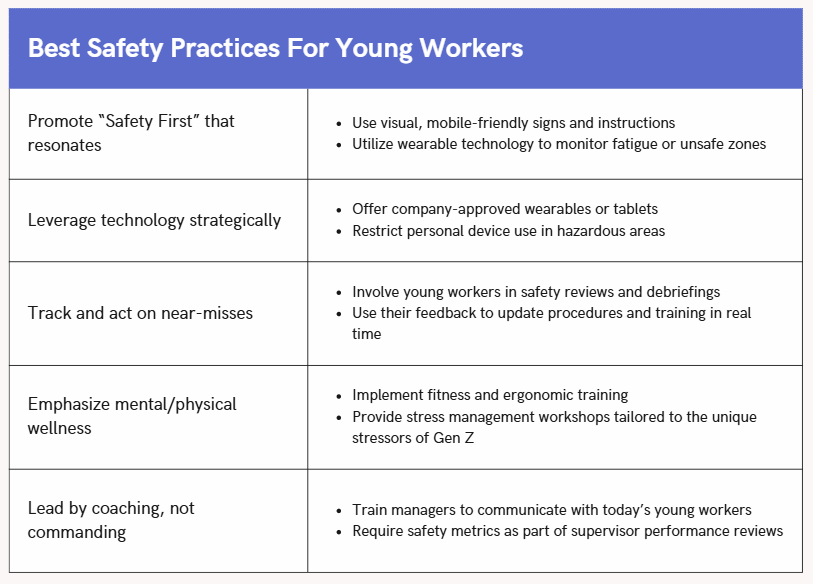
Understanding the mindset of Gen Z workers can help address both your labor needs and injury prevention goals. By using best practice tools, you can help these young workers excel. You’ll attract high-potential new employees who are eager to take on today’s industrial opportunities.
Contact us today to discover how Fit For Work’s comprehensive safety program can help you support and develop the next generation of workers, building strong foundations for long, productive careers.

Jocelyn Thoresen is an Athletic Trainer and Injury Prevention Specialist with over two years of experience helping workforces stay safe and perform at their best. She lives in Colorado with her husband, young daughter, and two dogs.