

By Forrest Richardson, CSP, ARME
Director of Safety, Fit For Work
Key Insights
- Hazard Communication remains OSHA’s most significant compliance change of 2026, with important employer obligations due by November 20, 2026.
- Heat illness prevention continues to be a major OSHA enforcement priority, even without a final federal heat standard.
- Warehousing, distribution, and occupational noise exposures remain key inspection focus areas under active OSHA enforcement initiatives.
- Several highly discussed topics, including Lockout/Tagout (LOTO) modernization and respiratory protection revisions, remain under development and are not new federal requirements today.
As 2026 enters its final months, OSHA’s regulatory landscape remains a mix of current compliance requirements and initiatives that are still under development.
The revised Hazard Communication Standard represents the most significant new compliance requirement employers need to address this year. At the same time, OSHA has increased inspection attention on heat illness prevention, warehousing and distribution operations, occupational noise, hazardous machinery, lockout/tagout, and other hazards associated with serious injuries.
For safety professionals, HR leaders, and operational decision-makers, the challenge is understanding what requires action today versus what remains a future regulatory development.
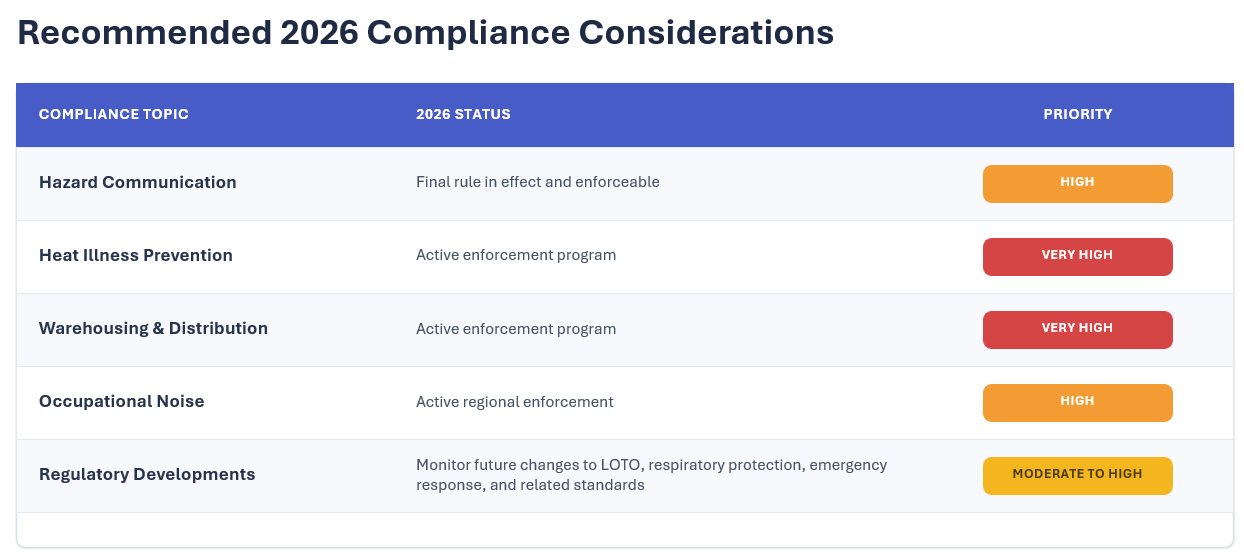
Fit For Work assessment based on current OSHA compliance requirements and enforcement activity as of September 2026.
OSHA Hazard Communication: The Most Significant Compliance Change of 2026
2026 Compliance Priority: HIGH
The revised Hazard Communication Standard (HazCom) continues to be the most significant regulatory change employers should prioritize before year-end.
OSHA’s 2024 HazCom final rule further aligned the standard with GHS Revision 7 and updated requirements related to chemical classification, aerosols, chemicals under pressure, labeling, and Safety Data Sheet (SDS) information.
One date deserves particular attention: November 20, 2026
By this date, employers must update workplace labels, written Hazard Communication programs, and employee training for affected substances, as necessary.
OSHA’s inspection directive, effective May 19, 2026, provides compliance officers with the framework they will use when evaluating compliance with the revised standard. During inspections, OSHA may review written Hazard Communication programs, chemical inventories, SDSs, labels, employee training, and employee knowledge of workplace hazards.
Heat Illness Prevention Remains a Top OSHA Enforcement Priority
2026 Inspection Priority: VERY HIGH
One point remains especially important: OSHA still does not have a final federal Heat Injury and Illness Prevention Standard.
However, that has not reduced OSHA’s enforcement focus.
The agency’s revised National Emphasis Program (NEP) for Outdoor and Indoor Heat-Related Hazards became effective April 10, 2026, reinforcing heat illness prevention as a major inspection priority. OSHA’s current agenda projects additional rulemaking activity through 2027, but the standard is not final today.
Employers should be prepared to demonstrate:
- Adequate drinking water
- Rest periods
- Recovery areas or cooling locations
- Acclimatization procedures
- Heat illness training
- Emergency response procedures
- Employee monitoring and hazard assessment
Even without a final standard, OSHA may continue using the General Duty Clause when the legal elements required for a citation are met.
For more heat-related information, including how to recognize early warning signs before a heat-related illness becomes an emergency, read our article, “Heat Illness in the Workplace: 10 Early Warning Signs Every Supervisor Should Know.”
OSHA Inspection Focus: Warehousing, Distribution, and Occupational Noise
2026 Inspection Priority: HIGH TO VERY HIGH
OSHA’s revised National Emphasis Program for Warehousing and Distribution Center Operations took effect July 31, 2026. The program allows for broad inspections that may include powered industrial trucks, material handling, walking-working surfaces, fire protection, heat hazards, and ergonomic risks.
For employers operating warehouses and distribution facilities, OSHA’s renewed focus increases the likelihood of comprehensive inspections under existing General Industry standards.
Occupational noise is also receiving increased enforcement attention through several regional emphasis programs. While the requirements of 29 CFR 1910.95 have not materially changed, employers should confirm that exposure assessments, hearing conservation programs, audiometric testing, training, and recordkeeping remain current.
OSHA Regulatory Developments to Watch
Several OSHA initiatives remain active but have not created new federal compliance obligations in 2026.
These include:
- Lockout/Tagout (LOTO) modernization
- Respiratory protection revisions
- Fixed ladder requirements
- Emergency Response Standard rulemaking
- Potential silica medical surveillance changes
Employers should continue complying with current standards while monitoring future developments.
OSHA 2026 Employer Resources
To help safety professionals, HR leaders, and operational teams prioritize compliance efforts before year-end, we’ve created two companion resources:
1) OSHA 2026 Enforcement Priority Scorecard
A one-page overview of OSHA’s current enforcement and compliance priorities.
📄Download the Scorecard (PDF)
2) OSHA Inspection Readiness Checklist
A practical tool to help organizations evaluate key compliance areas and identify potential gaps before an inspection occurs.
📄Download the Checklist (PDF)
Key Takeaways for Leaders
Now is the time that organizations should review several OSHA focus areas discussed above and confirm that programs, training, and documentation remain current and effective:
- Make Hazard Communication a top compliance priority, particularly with the November 20, 2026 deadline approaching.
- Strengthen heat illness prevention efforts, as heat remains one of OSHA’s most active enforcement priorities.
- Evaluate warehousing, material handling, and occupational noise programs, especially in facilities that may be subject to increased inspection activity.
In addition, employers should remember that OSHA’s maximum penalties remain significant, with serious violations carrying penalties of up to $16,550 per violation and willful or repeat violations carrying penalties of up to $165,514 per violation.
While several regulatory initiatives remain under development, OSHA’s focus in 2026 has been less about new standards and more about enforcement of existing requirements.
Need help preparing for a year-end compliance review? Contact Fit For Work to learn how we can help.
Resources

Forrest Richardson has served as the Safety Division Director for Fit For Work for 22 years. He has over 30 years of experience in environmental health & safety (EHS) compliance management and leads national, regional, and local EHS Compliance services for Fit For Work. Forrest holds the Certified Safety Professional (CSP), Associate Risk Management Enterprise (ARME), and Certified Safety Manager (CSM) certifications. He also facilitates the Fit For Work Safety Specialist professional development track, supporting EHS podcasts, white papers, blogs, and safety newsletters.
Forrest proudly served in the United States Army 25th Infantry Division, Big Red One and 1st Calvary 227th Assault Helicopter Divisions. He is a professional member of the American Society of Safety Professionals, serving as chapter president, and supporting national professional development conferences. As a guest speaker he supports national, regional, and local professional development conferences across general, construction, and oil and gas industries.