By Angela Lambert, LAT, ATC
Injury Prevention Specialist, Fit For Work
This article is part of our Body Basics series. If you missed the earlier posts, check out Parts 1 and 2 by clicking here.
Knee pain might seem inevitable for your industrial athletes, but it doesn’t have to be. Maintaining knee health is achievable through increased awareness of posture, proper lifting techniques, strengthening exercises, and improved flexibility. While that may seem like a daunting list to implement, the payoff to your employees, both personally and professionally, is well worth the investment.
Understanding the Knee
According to the Bureau of Labor Statistics (BLS), the knee ranks among the top three most commonly injured body parts in the workplace. As the largest joint in the human body, the knee plays a crucial role in mobility and stability, functioning much like a hinge. However, the knee has very limited side-to-side movement which makes it especially vulnerable to injuries caused by twisting motions or hyperextension, where the joint is forced beyond its normal range.
The knee’s main components are the menisci, ligaments, muscles, and nerves. The menisci function as shock absorbers that provide cushion on either side of the knee, while ligaments and muscles offer stability for the joint. The nerves provide sensation and motor control.
Common Hazards
Given its crucial role in body movement, the knee is especially vulnerable to injury. National Safety Council analysis of BLS data shows that knee injuries result in some of the highest days away from work (DAFW), with a median of 19 days, and days away, restricted, or transferred (DART), with a median of 26 days—where “restricted” refers to situations in which an employee cannot perform their normal job duties due to a work-related injury or illness but is still able to work in a limited or modified capacity.
While trauma-related injuries can result in major damage, minor injuries due to wear and tear are most common. Think about all the daily activities that involve the knee: walking, running, jumping, kneeling, lifting, and more. In fact, it’s difficult to list many activities that don’t involve the knee in some way.
A few common workplace hazards include:
- Twisting: Common with improper lifting technique, twisting the upper body impacts not only the lower back but also the knee by placing strain on the medial collateral ligament (MCL) as the knee collapses during the twist.
- Improper squatting: Placing too much pressure on a forward stance during squatting is a common mistake. Weight should be back on the heels, with knees not crossing beyond the toes.
- Kneeling without padding: Frequent kneeling without padding compresses the pillow-like menisci. Over time, this strain can lead to the menisci flattening and providing less cushion.
Who’s at Risk?
For older individuals, arthritis is a frequent cause of knee pain as the joint space narrows over time, influenced by both genetic and external factors. Implementing best practices can reduce discomfort for those who already deal with arthritic changes. In addition, these practices can slow the pace of arthritic development in younger industrial athletes.
Employees who frequently kneel, lift, stand, or walk for long periods are at risk of knee injury if correct posture, strengthening, and flexibility are ignored. Environmental factors are another important consideration. Those who routinely navigate wet or icy sidewalks and stairs should exercise caution to prevent injury.
Even employees who spend much of their day at a desk without microbreaks and attention to posture can experience knee pain. While not directly associated with the knee, sciatic nerve pain, often due to overly tight muscles like the piriformis (located deep in the buttock region, underneath the gluteus maximus), can cause severe discomfort or weakness down the back of the leg and across the knee.
Injury Prevention
Creating awareness is a foundational step in preventing workplace injuries. Many organizations find that combining educational materials, such as posters, brief conversations, and digital tools like QR codes, can effectively communicate safety best practices. Encouraging open dialogue not only reinforces these practices but also helps build trust and engagement among team members, fostering a culture of safety.
Preventing Escalation: A Case Study in Early Injury Intervention
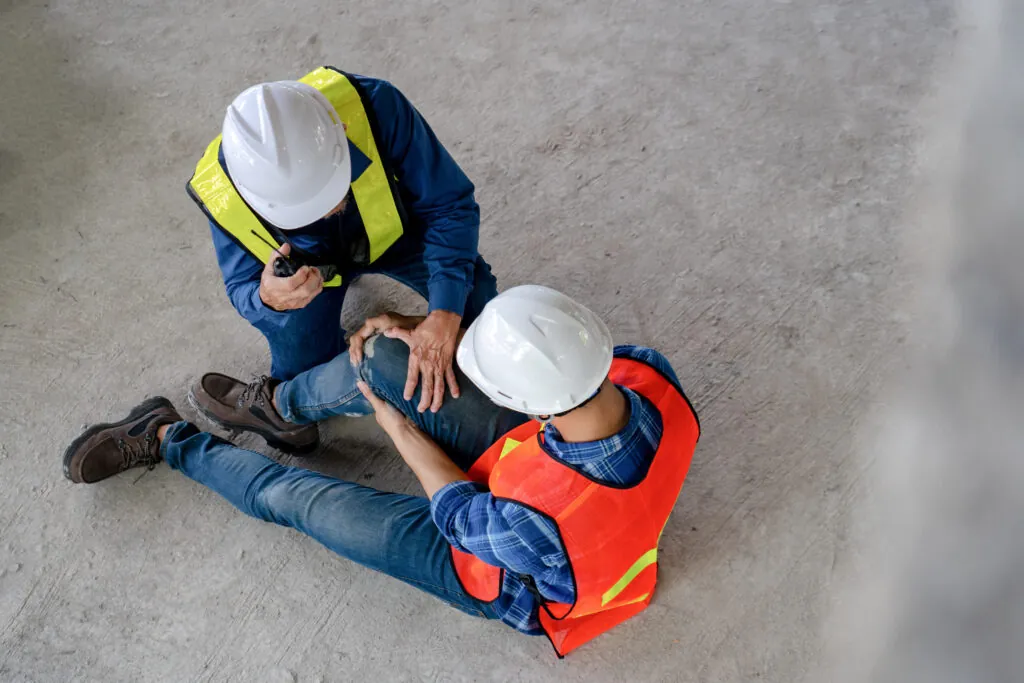
A delivery driver reported experiencing knee pain after descending a ramp with a loaded hand truck. The incident occurred when the driver stepped off the end of the ramp with the toe pointed outward, resulting in immediate discomfort. Upon evaluation, range of motion and strength tests indicated instability in the knee joint, suggesting a possible medial collateral ligament (MCL) sprain.
The employee was referred to a physician for further assessment, which confirmed the MCL injury. To support recovery, the employee was temporarily reassigned to light-duty work in the warehouse. Following medical clearance, a targeted strengthening program was introduced to reduce the risk of future injury.
This prompt response helped ensure accurate diagnosis and treatment, minimized downtime, and supported a safe return to full duties. Ignoring the pain and continuing to work despite the injury could have resulted in more severe damage and lost time.
Top tips for injury prevention include:
- Maintaining a healthy weight: Excess weight can cause the menisci to flatten more quickly.
- Emphasizing proper posture and lifting technique: Walk with toes facing forward, avoid squatting with knees extending beyond toes, and minimize twisting. For additional information on correct lifting technique, click
- Practice situational awareness: Lighten loads, be cautious in slippery conditions, and watch for trip hazards.
- Use PPE when appropriate: Knee pads reduce pressure when kneeling, and arch supports in footwear avoid excess strain on arches and surrounding muscles.
- Improve strength and flexibility: A balanced exercise plan will improve strength and stability; increasing flexibility through stretching will avoid imbalance from overly tight muscles.
These recommendations aren’t solely for the work environment; employees can benefit from following them at home, too.
Emphasize good posture, proper lifting techniques, plus strength and flexibility to reduce the risk of knee injuries.
Measurable Impact of Injury Prevention
While some organizations may be skeptical about the benefits of implementing comprehensive injury prevention programs—especially when it involves shifting workplace culture—the results speak for themselves. At one facility supported by Fit For Work, 30 injuries were prevented over the past year, resulting in more than $900,000 in annual cost savings. In high-output environments, every injury avoided not only protects workers but also contributes to operational efficiency and financial performance.
Conclusion
Knee pain doesn’t have to be inevitable for the industrial athlete. The benefits of implementing a program designed to prevent knee injuries through strengthening, flexibility, correct posture, and situational awareness can yield significant return on investment for your employees, both in the workplace and in their personal lives.
Contact us to learn more about our early intervention and ergonomic services—and how we can help support knee health and injury prevention across your workforce.

Angela Lambert is an Injury Prevention Specialist with more than 15 years of experience in athletic training and rehabilitation. She earned a bachelor’s degree in kinesiology with an emphasis in athletic training from Northern Illinois University in 2010. Her career includes four years in the high school athletic setting, nine years in physical therapy and rehabilitation, and the past two years with Fit For Work.
She is passionate about helping others through education, particularly in human anatomy, ergonomics, and injury prevention techniques. Outside of work, she enjoys attending sporting events, concerts, and spending time with her husband and two young children.