By Lauren Brizendine, MPH, CPE
Director of Ergonomics, Fit For Work
Key Insights
- Shortcuts may indicate that written procedure and actual work conditions are not aligned.
- Coaching cannot correct excessive force, awkward posture, or repetition to compensate for a poorly designed task.
- Leaders can make safer choices easier by improving task design, removing barriers, and involving employees in solutions.
Shortcuts often lead to preventable injuries, but why do employees ignore safety guidelines? Whether it’s skipping a lift assist device, using a tool differently than intended, or modifying a work process to save time, employees rarely take shortcuts simply because they do not care about safety. Employee behavior is influenced by habits, production demands, task design, available equipment, and workplace expectations. When the safest method is not the easiest method, employees may find workarounds that increase injury risk.
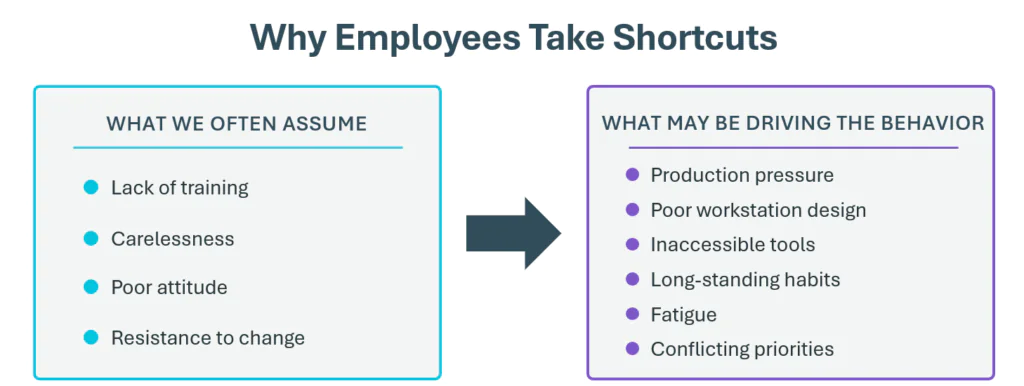
When employees take shortcuts, the behavior itself is often only part of the story.
Why Knowing Does Not Always Lead to Doing
According to the National Safety Council, one of the most common injury categories includes overexertion, repetitive motion, and bodily position injuries, which are often associated with moving or manipulating external objects, repetitive tasks, and awkward or sustained postures. Prevention is largely achievable, yet they constitute over 25% of occupational injuries involving days away from work. If safety guidelines and good ergonomic principles are in place, why are those prevention measures disregarded?
Employees may understand the recommended procedure but perform the task differently due to:
- Production or time pressures
- Long-standing habits and informal work practices
- Fatigue, discomfort, or distraction
- Inconvenient or unavailable tools and equipment
- Workstation layouts that make proper technique difficult
- Conflicting expectations between safety and productivity
A shortcut may indicate that the written procedure and actual work conditions are not aligned.
Look Beyond Employee Behavior
Before labeling an action “unsafe,” consider:
- Is the recommended method realistic during normal production?
- Does the task design allow the employee to use the expected posture or technique?
- Are the necessary tools and controls accessible?
- Are supervisors consistently reinforcing the practice?
- Are productivity expectations unintentionally encouraging shortcuts?
Coaching cannot correct excessive force, awkward posture, or repetition when the task itself is poorly designed. Redesigning tasks and procedures to implement ergonomic solutions should allow employees to perform the work in the safest, easiest, and most productive way. Remember—ergonomics should not compete with productivity. Good ergonomic solutions aim to reduce physical demands while either maintaining or increasing productivity and improving the quality of work.
Coaching cannot correct excessive force, awkward posture, or repetition when the task itself is poorly designed.
6 Best Practices to Make the Safe Choice Easy
Organizations can support safer decisions by consistently implementing these six recommendations:
- Improve workstation, tool, and task design.
- Keep ergonomic equipment accessible and functional.
- Provide brief, task-specific coaching at the point of work.
- Use visual cues and consistent reinforcement.
- Involve employees in assessments and equipment trials.
- Recognize employees who identify risks and recommend improvements.
What Does This Look Like in Practice?
If a tool improvement or change is needed, start with a trial across a small group of employees for several weeks. Establish a feedback process and checkpoints to gauge progress and note recommendations. For example, a new tool may function well, but the grip diameter is uncomfortably small. A too-heavy pick stick may solve a reach issue, but its weight causes new discomfort. Solving one risk factor while creating another is not a viable solution.
Even when the right tools and equipment are available, employees may still need training and reinforcement to use them effectively. Information may have been provided, but this does not confirm that the employee can perform the expected method. Processes also change, requiring frequent evaluation to ensure procedures reflect current work conditions. Supervisors should provide regular reminders and training to keep employee knowledge fresh and up to date.
Behavioral coaching is designed to be efficient and productive, creating faster and better output when applied correctly. In the case of a fast-moving production line that involves reaching for product on a floor-level pallet, a self-leveling pallet carousel that brings product to waist level improves efficiency and comfort. A pallet that is located several steps away from the conveyor should be moved closer to reduce unnecessary walking. Eliminating wasted movements and relieving fatigue improve both productivity and safety.
Use Employee Engagement to Identify Barriers
The goal is to gather information to develop helpful solutions that make the job easier, and the most efficient way to achieve that is by leveraging the expertise of employees already responsible for those tasks. When engaging with employees, it is essential to maintain a curious mindset. A foundation of good rapport will improve employee comfort with sharing honest feedback. Avoiding bias is important, so involvement of onsite injury prevention providers can improve the quality of communication and information collected.
Onsite providers are well positioned to ask employees:
- “What makes this task difficult?”
- “When is the recommended method hardest to follow?”
- “Why is the task sometimes performed differently?”
- “What would make the safer method easier?”
These conversations help identify practical barriers and often lead to more effective, sustainable solutions. In some cases, this looks like discovering that an existing lift assist device is unused because it requires specific techniques and manual adjustments for product placement. Additional training may be needed to increase employee efficiency to a point that using the lift becomes the most natural choice. In other cases, employee feedback and observation uncover the need for a tool change. One case involving assembly tasks stands out:
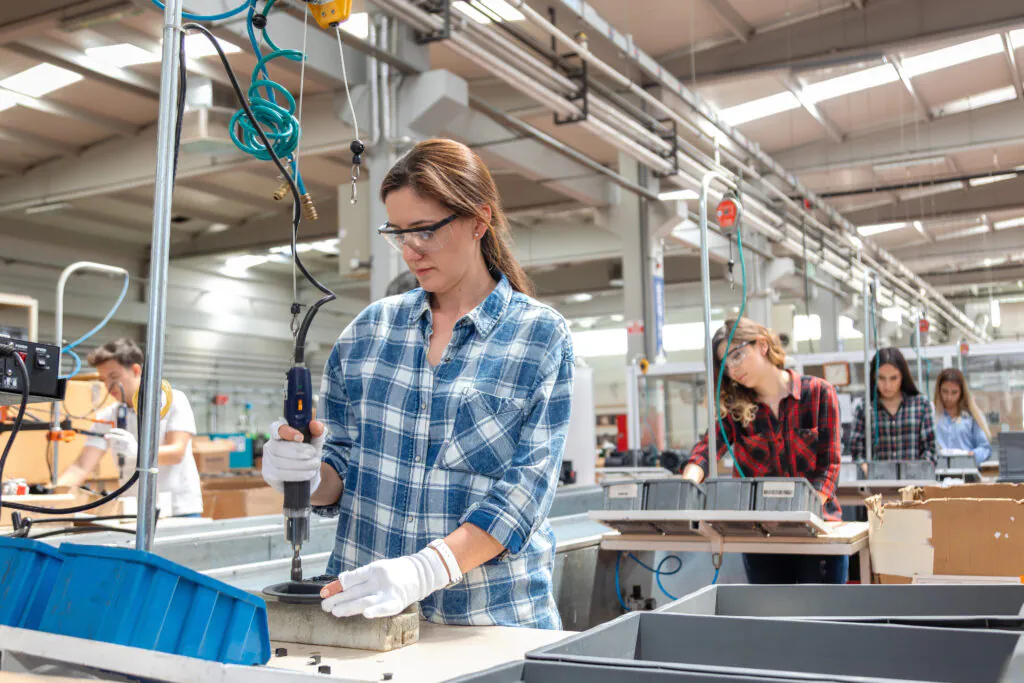
A lighting factory had assembly stations with components at waist level and provided employees with pistol-grip drivers, which are best suited for horizontal screw placements. Some assembly tasks also required vertical screw placements, forcing employees to position the tools at awkward angles and creating significant shoulder strain. The best solution was to provide employees with in-line drivers suspended from above with a tool support, reducing the physical effort required to complete the task. In this case, the factory already had the needed in-line drivers in storage and quickly reinstated them.
Conclusion
Instead of only asking, “Why didn’t the employee follow the procedure?” look deeper for a root cause. What factors made that decision seem reasonable at the time? Effective injury prevention combines employee coaching with better task design, leadership support, and removal of barriers to safe work. When the safest method is also the easiest and most efficient method, employees are more likely to use it consistently.
Need help identifying barriers to safe work? Fit For Work’s ergonomics and injury prevention experts help organizations evaluate tasks, identify ergonomic risk factors, and implement practical solutions that support both safety and productivity. Contact us to learn how we can help make the safe choice easier for your workforce.

Lauren Brizendine is Director of Ergonomics at Fit For Work, where she oversees ergonomics subscriptions and projects for clients across the United States. She earned a Bachelor of Science in animal science and a Master of Public Health in environmental and occupational health from Texas A&M University and is a Board-Certified Professional Ergonomist (CPE).
Since joining Fit For Work in 2013, Lauren has worked with clients across nearly every industry, completing thousands of physical demands analyses, ergonomic assessments, physical agility tests, and office ergonomics assessments. She also serves on the Industry Advisory Board for the Ergonomics Center at Texas A&M University.